
Canola Oil = Canada Oil, Low Acid.
Canola oil is a paradox. It’s promoted by major health organizations as a heart-healthy choice, yet vilified by nutrition experts as a processed, inflammatory food. To understand this divide, we must follow its unlikely journey from a field in Canada to the highly refined bottle on your shelf. This is a story of scientific ingenuity, industrial processing, and unintended consequences.
Part 1: The Origin – Creating an Edible Oil from an Industrial crop
The story begins not with “canola,” but with rapeseed.
- The Original (Industrial) Rapeseed: For centuries, rapeseed was cultivated for its oil, which was an effective lubricant for steam engines and a key ingredient in plastics, inks, and biofuels. However, it was utterly unsuitable for human consumption. The seeds contained two problematic compounds:
- High Erucic Acid: Shown to cause heart damage in animal studies.
- Bitter Glucosinolates: Gave the oil and the leftover meal a sharp, unpalatable taste.
- The Scientific Makeover (1970s): Canadian plant scientists wanted to create an edible, profitable oil crop. Using traditional selective breeding (not genetic modification at this stage), they cross-bred rapeseed plants that naturally had lower levels of these undesirable compounds. After years of work, they created a new, stable variety of the plant.
- A New Name for a New Product: To distinguish this new, safe-to-eat oil from its industrial predecessor, it was renamed CANOLA, a contraction of “Canada Oil, Low Acid.” This was a marketing masterstroke, creating a new brand with no negative associations.
At this point, canola was a success story: a new, edible oil created through classic agricultural science.
Part 2: The Industrial Overhaul – How Canola Oil is Really Made
This is where the story takes a turn. Unlike extra-virgin olive oil, which is simply pressed out from olives, the vast majority of canola oil undergoes an intense, multi-step industrial refining process designed to create a neutral-tasting, clear, and shelf-stable product.
Here is the journey of a conventional canola seed to oil:
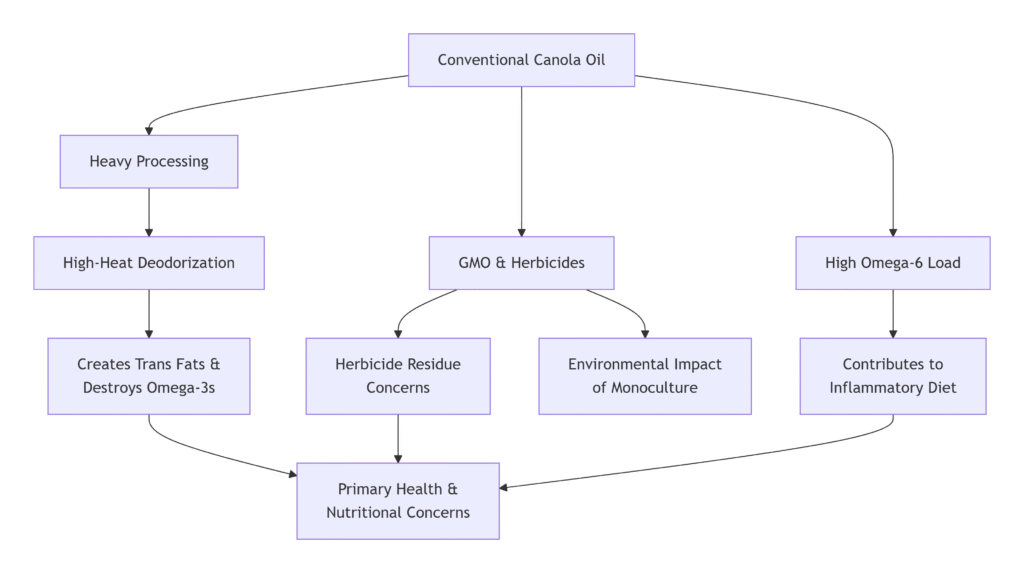
- Genetically Modified Seeds (The New Normal): After canola was established as an edible crop, agribusinesses introduced genetically modified (GMO) varieties. Over 90% of North American canola is now engineered to be herbicide-tolerant, allowing fields to be sprayed to kill weeds without harming the crop. This raised concerns about pesticide residue and environmental impact.
- Solvent Extraction: The seeds are crushed and then washed with a petroleum-based solvent, usually hexane, to extract up to 99% of the oil.
- High-Heat Processing: The crude oil undergoes a series of harsh steps:
- Degumming: Chemicals and water are used to remove impurities.
- Bleaching: The oil is filtered through clay to remove color and remaining impurities.
- Deodorizing: The oil is steamed and heated to very high temperatures (over 450°F / 230°C) to remove odors and flavors. This is the most damaging step:
- It destroys the fragile omega-3 fatty acids (ALA) that the oil is marketed for.
- It creates artificial trans fats. While the final product can be labeled “0g trans fat” (due to labeling loopholes), this process does create them, with studies finding levels up to 4.2%.
The final product is a pale, odorless, nutrient-poor oil that is a far cry from the seed it came from.
Part 3: The Problem – Why This “Healthy” Oil Is Considered Bad for You
The health claims for canola oil are based on its theoretical fat profile: low in saturated fat, high in monounsaturated fat, and a source of omega-3s. However, this ignores the reality of its processing and its role in the modern diet.
Here’s why it’s considered unhealthy:
- The Processing is the Primary Problem: The high-heat deodorization process creates trans fats and destroys the beneficial omega-3s, turning them into potentially rancid fats. Consuming even small amounts of artificial trans fats is linked to inflammation, heart disease, and other chronic illnesses.
- It’s a Major Source of Inflammatory Omega-6: Canola oil is high in polyunsaturated fats, specifically omega-6 linoleic acid. While essential in small amounts, our modern diets are flooded with omega-6 from processed foods. Canola oil is a primary source. An extreme imbalance between omega-6 and omega-3 intake drives systemic inflammation, a root cause of many diseases.
- The GMO and Pesticide Concern: For many, the heavy use of glyphosate and other herbicides on GMO canola crops presents a potential health and environmental risk they wish to avoid.
- It’s the Backbone of Ultra-Processed Foods: Canola oil is the default, cheap fat in the packaged food industry. When you eat chips, crackers, cookies, and fried foods, you are almost certainly consuming canola oil. Therefore, its health profile is intrinsically linked to the harms of a diet high in ultra-processed foods.

The Bottom Line: A Processed Product, Not a Whole Food
The journey of canola oil is a story of transformation. It was successfully bred to be edible, but then industrialized to become a commodity.
For most people, the conventional canola oil on the shelf is a triple threat: it’s typically GMO, heavily processed, and a major source of inflammatory fats in the diet.
While an occasional use is unlikely to cause harm, making it a primary cooking oil means consistently consuming a refined product with questionable health benefits. Opting for inherently stable, less processed oils like extra virgin olive oil and avocado oil is a more reliable path to long-term health.